
You submit a score, wait for the handicap record to update and see the same number as yesterday.
The immediate suspicion is understandable: the score did not go through, the app is wrong or the committee needs to press a button.
Sometimes there is a data problem. More often, nothing is wrong. A score can be completely valid, appear in the record and leave the displayed Handicap Index unchanged.
That is because WHS does not adjust the old index up or down by a fixed amount after every round. It recalculates from a moving set of Score Differentials. The new round is evidence, but it is not guaranteed to become one of the values used in the average.
A score is not a Score Differential
The gross number on the card is only the beginning.
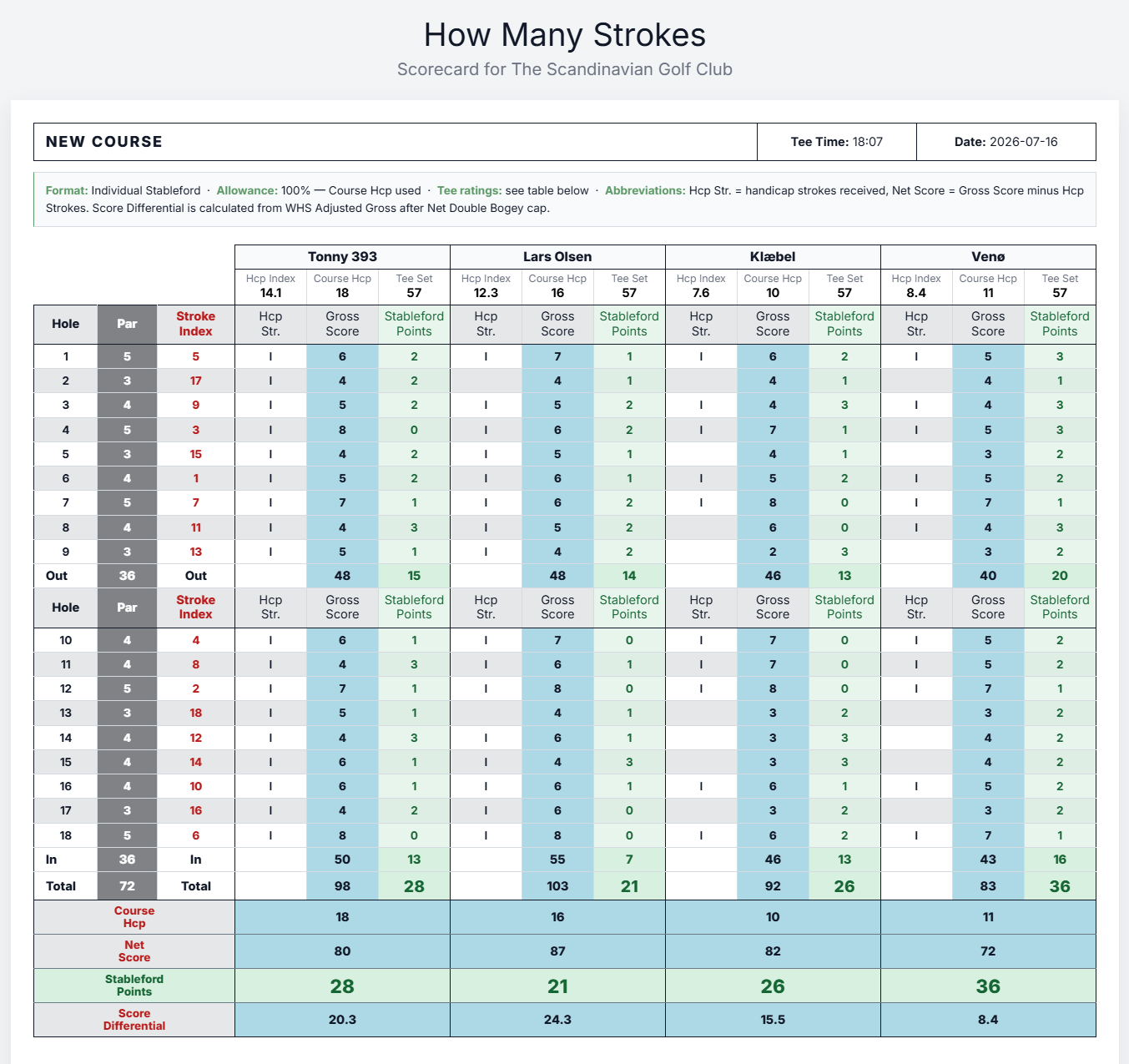
For handicap purposes, hole scores are first limited where necessary. A player with an established Handicap Index has a maximum of net double bogey on each hole. The adjusted gross score is then converted into a Score Differential using the Course Rating, Slope Rating and any Playing Conditions Calculation.
An 84 on one set of tees may produce a differential of 10.7 and an 84 elsewhere 14.1. The Rules of Handicapping use differentials to put rated courses onto a common basis. The index does not average gross scores or Stableford points.
Before asking why the index did not change, check the new differential. “I played well” may be true while the round was still not better than the scores already driving the calculation.
The lowest eight of the most recent 20
Once a player has 20 Score Differentials, the basic calculation uses the lowest eight of the most recent 20, rounded to the nearest tenth.
Suppose the eight counting differentials are:
11.9, 12.4, 12.8, 13.1, 13.6, 14.0, 14.2 and 14.6
Their average is 13.325, which displays as a Handicap Index of 13.3 before any cap or other applicable adjustment.
Now the player submits a differential of 15.1. It enters the record, but it is not among the lowest eight. If the score dropping out of the 20-score window was also non-counting, the same eight remain and the index stays 13.3.
Nothing has been ignored. The new round is in the record. It simply does not alter the current estimate of demonstrated ability.
This is the most common explanation for a bad score not moving the handicap upwards. One poor round is usually outside the lowest eight. WHS is deliberately more interested in the player’s better demonstrated performance than in one difficult afternoon.
Even a counting score may not move the displayed number
Change the example slightly. The new Score Differential is 14.4, so it replaces 14.6 among the lowest eight.
The new average is 13.3 when rounded to one decimal place. The underlying average improved by 0.025, but the displayed Handicap Index remains 13.3.
The score counted. The movement was simply smaller than the tenth shown on screen.
This explains why a golfer can see a star, highlight or other “counting” indicator beside a new round while the headline number appears unchanged. National platforms display the record differently, but the underlying rounding rule is common.
The score leaving the record can matter more
Every new differential pushes the oldest one out of the most recent 20.
If the departing score was not counting, a new non-counting round may change nothing. If the departing score was one of the lowest eight, the index may rise even when the new round felt acceptable. A previously ninth-best differential moves into the calculation to replace it.
This rolling-window effect often surprises players. They look only at today’s score, while the calculation is also saying goodbye to a round played months ago.
A useful handicap display should therefore make three things easy to see:
- the new Score Differential;
- which eight values are currently used; and
- which score has just left the 20-score window.
The answer is usually visible when those three are read together.
Fewer than 20 scores use a different table
A new or returning golfer does not wait for 20 scores before receiving an index.
The current calculation table uses fewer differentials and, at certain stages, an adjustment:
- Three scores: the lowest one, minus 2.0.
- Four scores: the lowest one, minus 1.0.
- Five scores: the lowest one.
- Six scores: the average of the lowest two, minus 1.0.
- Seven or eight scores: the average of the lowest two.
- Nine to 11 scores: the average of the lowest three.
- Twelve to 14 scores: the average of the lowest four.
- Fifteen or 16 scores: the average of the lowest five.
- Seventeen or 18 scores: the average of the lowest six.
- Nineteen scores: the average of the lowest seven.
At these thresholds, adding a score can change both the values available and how many values are averaged. The direction is not always obvious from the latest round alone.
A very good score can trigger more than the average
An exceptional score is handled differently.
Under Rule 5.9, a Score Differential that is at least 7.0 strokes lower than the Handicap Index in effect when the round was played triggers an exceptional-score reduction. The reduction is applied to the most recent differentials in the record and can accumulate if there are multiple exceptional scores.
It also means that two apparently similar “good scores” can have different effects. One may merely join the lowest eight. Another may cross the exceptional-score threshold and affect the wider record.
The Handicap Committee can review and, where justified, override an exceptional-score adjustment if it would make the index an unfair reflection of demonstrated ability. The calculation is automated, but governance has not disappeared.
Why a poor score may not raise the index as expected
WHS includes a soft cap and a hard cap once a Low Handicap Index has been established.
The Low Handicap Index represents the player’s lowest index during the 365 days before the most recent score in the record. If a newly calculated index rises more than 3.0 strokes above that reference, the soft cap restricts half of the increase beyond 3.0. After that, the hard cap limits the increase to no more than 5.0 strokes above the Low Handicap Index.
The caps apply to upward movement, not downward movement. Their purpose is to stop a temporary run of higher scores producing an unlimited rapid rise.
A player recovering from injury or experiencing a genuine long-term change may therefore need the Handicap Committee to review the record. The right response is evidence and a committee review, not submitting extra poor rounds in the hope that the calculation eventually catches up.
Timing and national interfaces
The common rule is that a Handicap Index should update no later than the day after a score is submitted, or as soon as possible thereafter. Scores should be submitted promptly on the day of play and before midnight local time.
How that journey looks differs. One national app may display a provisional change immediately, another may wait for overnight processing, and a club competition system may pass the result into the national record in a separate step.
Those interfaces do not change the lowest-eight formula, but they can explain why a competition result appears before the updated index.
If a score is absent rather than merely non-counting, check:
- Was it acceptable for handicap purposes?
- Was the correct player, date, course and set of tees used?
- Has the competition been closed and sent to the national record?
- Was the score submitted in the required form and certified?
- Is overnight processing still pending?
These are data-flow questions. They are different from a score that is present but does not alter the calculation.
A better clubhouse explanation
“The computer says no change” is technically possible and operationally unhelpful.
A useful answer has three steps:
- Show the new differential. This explains how the round compared after course difficulty and applicable adjustments.
- Show the counting set. Is the new value among the lowest eight, or the smaller number used for a developing record?
- Show the rolling change. Which old score left, and did rounding, a cap or an exceptional adjustment apply?
Most questions can be answered in less than a minute when the full record is visible.
The important distinction is simple: submitting a score updates the evidence. It does not guarantee movement in the displayed Handicap Index.
A stable number after one round is not proof that WHS failed to notice. Quite often, it is proof that the system remembered the other 19 as well.
Primary sources
- The R&A: Rule 5, Handicap Index Calculation
- The R&A: Rule 3, Adjustment of Hole Scores
- The R&A: Rule 4, Submitting a Score
- USGA: Rule 5.2a, Calculation with Fewer Than 20 Scores
Evidence reviewed 24 July 2026. Players should use the procedures and current interface guidance issued by their national association.