
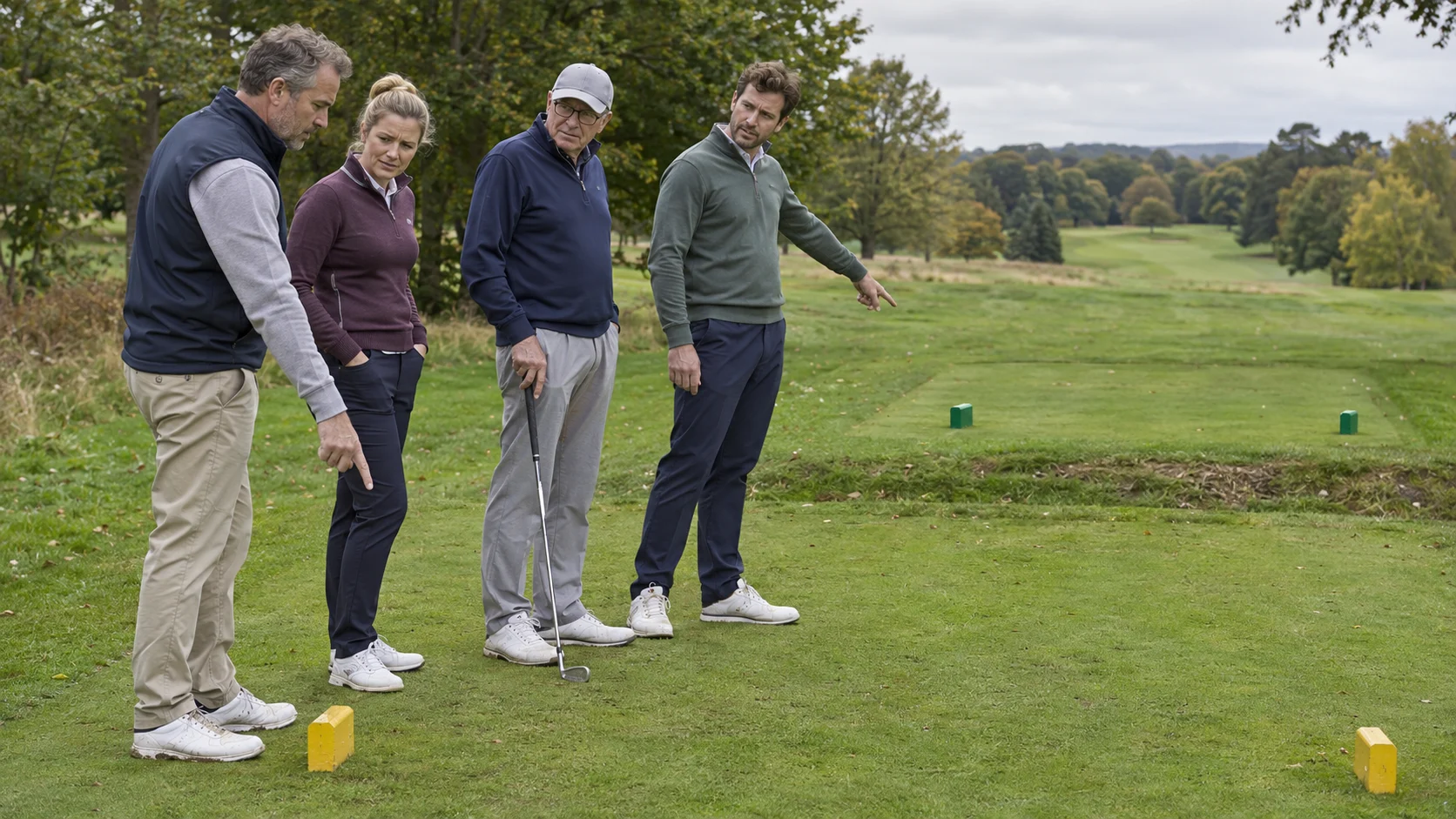
A golfer moves to a shorter set of tees. The Course Rating is lower. The Slope Rating is lower. Yet the handicap table gives almost the same number of strokes.
It is easy to conclude that the table is wrong. But another number may have changed: par.
A course can legitimately be par 72 from the yellow tees and par 69 from the green tees. The difficulty comes when the club’s systems know this, but the golfer’s scorecard does not.
Different pars can work fairly. They also create extra opportunities for misunderstanding and scoring errors. Clubs should review whether those differences remain appropriate, and whether standardising par would make golf easier to understand.
Par and course difficulty do different jobs
Par describes the score a scratch player would generally be expected to make on a hole under normal conditions, allowing for two putts. Course Rating assesses the difficulty of a particular set of tees for a scratch player. Slope Rating describes the relative difficulty for players who are not scratch players compared with scratch players. These are separate concepts in the Rules of Handicapping definitions.
A shorter tee does not need a lower par simply to recognise that it is easier. Its Course Rating and Slope Rating already reflect its assessed challenge. Two tees can both be par 72 while having substantially different ratings.
However, it would be inaccurate to dismiss every par difference as an outdated substitute for rating. A hole may genuinely play as a par 5 from one tee and a par 4 from another. Length, effective playing conditions and design all matter. A club’s arrangements may have a history, but their age alone does not establish why they were adopted or whether they remain appropriate.
The useful question is whether each designation makes sense today. Our explanation of Course Rating, Slope and par covers the underlying distinctions in more detail.
Why a shorter tee can give the same handicap
For an 18-hole round under the WHS method that includes Course Rating minus par:
Course Handicap = Handicap Index × (Slope Rating ÷ 113) + (Course Rating − par)
This is the calculation in Rule 6.1a. Par is part of the conversion, so a lower Course Rating does not necessarily mean a lower displayed handicap if par also falls.
Consider this entirely fictional example for a player with a Handicap Index of 12.0. Both ratings apply to the same player category.
| Measure | Yellow tees | Green tees |
|---|---|---|
| Par | 72 | 69 |
| Course Rating | 70.4 | 68.5 |
| Slope Rating | 128 | 118 |
| Unrounded Course Handicap | 11.99… | 12.03… |
| Rounded Course Handicap | 12 | 12 |
| Par + Course Handicap | 84 | 81 |
The golfer receives 12 strokes from either tee, but those strokes are measured against different pars. The resulting reference totals are 84 and 81. They are useful handicap benchmarks, not predictions of an average round.
If the green tees were appropriately redesignated par 72 with their ratings unchanged, the rounded Course Handicap would become 9. The reference total would still be 81: 72 + 9 instead of 69 + 12.
Changing the par label has not made the physical course harder or easier. It has changed how the handicap is expressed.
The real danger is using two different versions of par
Imagine the handicap calculator uses par 69 for the green tees, while a shared scorecard displays only the yellow tees’ par-72 row. A golfer checks the calculator using the card and obtains a different answer. Both the suspicion and the arithmetic are understandable; the inputs do not match.
The problem becomes more serious when that same card is used for Stableford.
Suppose a hole is officially par 4 from the golfer’s tee. The golfer takes five strokes and receives one handicap stroke on that hole. The net score is four, earning two points in ordinary Stableford against par. If the golfer mistakenly uses a printed par of 5, the same score appears to earn three points. The Stableford scoring rules make the hole’s scoring target essential.
Repeat that mistake on several holes and the result can be distorted. It is not necessarily one extra point on every affected hole, because Stableford has a zero-point floor. The effect depends on the actual scores.
This is different from a flaw in Course Rating or Slope. A correct calculator cannot compensate for players scoring against the wrong par. Nor is changing the stroke index an automatic solution: stroke index identifies where handicap strokes are allocated; it does not replace the correct hole pars.
Publishing only the total is insufficient. Golfers need the correct par for each hole, clearly associated with their tee and the applicable men’s or women’s rating. The rules even address scorecards and scoring terminals showing different pars in Clarification 4.1a/1.
Different formats need different treatment
Another source of mistakes is assuming that every mixed-tee competition needs the same adjustment.
Under Rule 6.2b, stroke play and match play using gross or net scores require an adjustment for different pars. A player on the higher-par tees receives the par difference in additional strokes, added to Playing Handicap after the handicap allowance. There is also an alternative method using a reduction for lower-par tees.
For a simple illustration, use a 100% allowance with the fictional tees above. Two players with those Course Handicaps shoot 84 from yellow and 81 from green. Subtracting 12 from both produces net 72 and net 69. Adding the three-stroke par difference to the yellow player’s Playing Handicap produces 15, making both net scores 69.
Do not carry that extra three-stroke adjustment into ordinary Stableford. When each player scores against the correct par for their own tees, no additional par-difference adjustment is required. If each makes net par on all 18 holes, each scores 36 points. Formats scored relative to par and Par/Bogey also have their own treatment under Rule 6.2b.
The club must therefore identify the format, apply its allowance and use the relevant rules. A Course Handicap table alone is not always the final competition handicap. For software calculations, Rule 6.2a calls for retaining the unrounded Course Handicap until the Playing Handicap calculation is complete.
Why standardising par deserves consideration
This is more than a preference for tidier scorecards. Appendix F of the Rules of Handicapping recommends standardising par across tee sets where appropriate. It considers how a hole is designed to be played, rather than treating a yardage threshold as the only deciding factor.
The USGA’s position paper on par also identifies simpler administration, fewer scorecard conflicts and a better golfer experience as benefits. Its policy is specifically for US implementation; European clubs should work with their own authorised association.
For a club, the operational case is straightforward: fewer par variations mean fewer versions to communicate and fewer opportunities to combine the right handicap with the wrong scoring target. Staff spend less time explaining apparently contradictory numbers. Visitors have less information to decode before playing.
But uniformity is not an end in itself. A substantially different tee can change the nature of a hole. Where different pars remain appropriate, clear information and correct competition administration are perfectly valid solutions.
A par review does not always require re-rating
The first request to the authorised association should be: “Please review our par designations and confirm that the ratings accurately represent the tees we use.”
If the physical course and ratings are still accurate, agreeing a different par may not require changing Course Rating or Slope Rating. The handicap tables will nevertheless need recalculating. Re-rating should assess actual playing difficulty, not manufacture ratings to produce a preferred handicap.
Where tees, lengths, obstacles or the layout have changed, a rating review is important. Appendix G makes the authorised association responsible for issuing ratings and deciding whether permanent course changes require re-rating. It also requires periodic re-rating: within five years for a new course, then at least every ten years.
Changing par alone does not directly change the 18-hole Score Differential formula, which uses adjusted gross score, Course Rating, Slope Rating and the Playing Conditions Calculation. However, hole-score caps depend on par and allocated strokes, so it would be too strong to promise that every future handicap result must remain identical. See Rule 5.1a and the definition of net double bogey.
What the club should do next
- Establish one approved set of data for every tee and applicable player category: hole pars, total par, Course Rating, Slope Rating and stroke indexes.
- Ask the association to review differences and decide whether standardised par is appropriate and whether re-rating is necessary.
- Update every player-facing surface together: scorecards, tee signs, handicap tables, website, app and competition software.
- Check real scoring examples in both Stableford and net stroke play, including a hole whose par differs. Check allowances and rounding separately.
- Explain any change before play, and give one member of staff responsibility for keeping the information consistent.
This is part of the Handicap Committee’s responsibility for reliable course data. Clubs should not have to defend confusing information merely because the calculation behind it is correct. The aim is a setup that is accurate in the system, clear on the scorecard and understandable to the person standing on the first tee.