
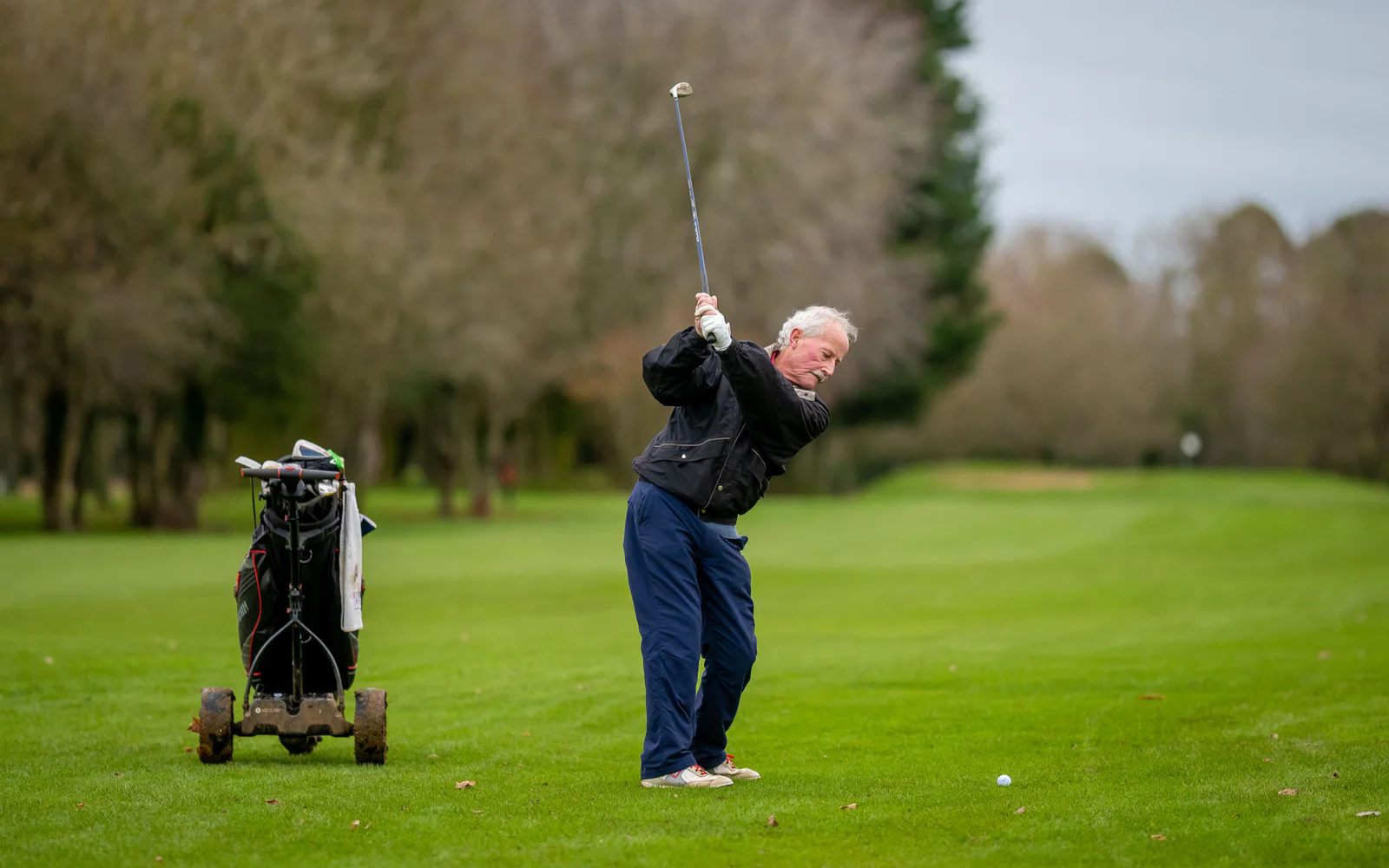
You hear it regularly on the first tee: “We are taking buggies so we can keep the pace up.”
It sounds obvious. A golf buggy travels much faster than a person walking. But a fast vehicle and a fast fourball are not the same thing. Once two golfers share a buggy, stop at different balls, choose clubs, wait, return to the path and repeat the exercise, much of the apparent advantage can disappear.
An organised group of walkers can often move in parallel: four people walk towards four balls and prepare four shots at the same time. A shared-buggy group can easily turn the same process into a sequence.
That does not make walking universally faster. It means clubs should stop treating “buggy” and “quick” as synonyms.
The short answer
Walking is often as fast as, or faster than, sharing buggies when:
- golfers can walk directly to their own balls;
- two players in a buggy repeatedly wait for one another;
- buggies must remain on paths;
- the course has awkward cart routing;
- walkers are ready to play when they reach the ball; and
- the course is busy enough that a faster vehicle only reaches the next queue sooner.
Buggies are more likely to save time when:
- there are long transfers between holes;
- the course is unusually hilly or spread out;
- players have mobility or health limitations;
- extreme heat makes walking unsafe or unrealistic;
- the buggy can travel sensibly on the playing area; and
- the people sharing it use it efficiently.
The answer depends on the course, the policy and the players.
Vehicle speed is not group speed
A walking golfer generally travels at roughly 4.5 to 5 kilometres per hour (about 3 miles per hour). A buggy can travel several times faster. If the task were simply to get one person from the first tee to the eighteenth green, the buggy would win easily.
Golf is not that task.
A group has to locate several balls, make several decisions and play several shots. Four walkers can separate after each stroke and take a direct route. With two shared buggies, the movement often looks like this:
- Drive to the first player’s ball.
- Wait while that player assesses and plays the shot.
- Return to the buggy.
- Drive across to the second ball.
- Repeat.
The USGA has observed that walking golfers are often faster than golfers sharing carts. Its more recent pace-of-play guidance makes the same practical point in another way: drop one player at their ball and move towards the other ball rather than sitting together and waiting.
This is not really an argument about transport. It is an argument about parallel work versus serial work.
The classic shared-buggy mistakes
Most of the lost time comes from small habits rather than one dramatic delay.
Common delays are simple. One player remains in the passenger seat while the other plays. Both drive to every ball, the passenger waits until arrival to choose a club, the buggy is parked where the group must walk backwards after the shot and scores are entered before leaving the green.
Each incident may cost only seconds. Repeated across 18 holes, it becomes noticeable.
The better routine is simple:
- where safe, drop one player with the likely clubs;
- let the driver continue towards the second ball;
- park on the exit side of the green;
- take the putter when a ball is played towards the putting surface;
- record scores at the next tee; and
- keep conversations going while moving, not while everyone is ready and waiting.
Ready Golf matters for walkers too. Efficient walkers go directly to their own balls, make decisions while others play and move promptly when it is safe.
Cart-path-only changes the calculation
The R&A’s Pace of Play Manual highlights the effect of cart-path design. If the path lies on only one side of a hole, golfers may have to walk a substantial distance to a ball on the opposite side and then return to the buggy. Wet-weather restrictions can make this a common autumn and winter problem.
In that situation, the buggy does not remove walking. It adds a return journey.
A walker can usually take a direct line, subject to ropes and protected areas. The buggy user travels by path, estimates the distance, chooses several possible clubs, walks across, plays and walks back.
There is no defensible universal claim that this adds a particular number of minutes. The effect depends on path location, hole width, weather, player preparation and where the shots finish. But the direction of the effect is clear: path restrictions reduce the buggy’s pace advantage and can reverse it.
Clubs should therefore treat “buggy pace” as a condition-specific question. A policy that works in firm summer conditions may be poor in a wet February.
A buggy cannot solve a queue
The wider pace-of-play system matters more than either mode of transport. If groups start closer together than the course can absorb, a buggy only reaches the queue sooner. It cannot increase the capacity of the next par 3, remove a search in deep rough or create another safe landing area.
The USGA compares this with putting faster cars into congested traffic: the vehicles have more speed, but the road still has the same bottleneck. The R&A likewise places management practices and course set-up alongside player behaviour in its pace guidance.
For clubs, the lesson is practical. More buggies may not shorten rounds when tee intervals, starting discipline, rough height, hole locations, green speed, cart routing or group sizes are the real constraint.
The health evidence is clearer than the pace evidence
Research comparing walking and riding tells us much more about physical load than round time.
A 2025 randomised study followed 16 young male competitive golfers over two rounds on a 6,587-metre course (7,204 yards). In one round they walked with caddies; in the other they used buggies. The walking rounds averaged approximately 17,000 steps and 880 kilocalories of activity energy expenditure, compared with about 6,300 steps and 456 kilocalories when riding.
Walking also produced higher heart rates and perceived exertion. Shot-performance measures such as clubhead speed, ball speed and carry distance did not differ in that small study.
Those figures should be used carefully. The participants were young, male and highly skilled. They were playing competitive golf on one championship course, and the study was not designed to determine which group completed the round faster. It supports a health-and-workload conclusion, not a universal pace claim.
Another study of 16 low-handicap golfers found substantial physical activity when carrying, using a manual trolley or using an electric trolley. Differences among those walking methods were modest beside the larger difference between walking and riding in the later study. A broader review concluded that golf can provide moderate-intensity physical activity, and earlier controlled research among sedentary middle-aged men found improvements after regular walking golf. These findings support the health value of walking, not a promise for every player or a claim that riding is unhealthy.
Course design and climate shape buggy use
At many clubs in Great Britain, Ireland and the Nordic countries, walking with a carry bag, push trolley or electric trolley is normal. Buggies may be associated mainly with mobility needs, visitors or particular weather conditions.
At hilly resort courses and in warmer parts of Southern Europe, riding can be much more common. Long distances from greens to tees, resort routing and summer heat may make a buggy the realistic choice. Some courses are effectively designed around motorised transport.
Neither model is inherently correct. Problems begin when a club imports an assumption from one setting into another.
A flat Danish club with short green-to-tee walks should not assume that encouraging buggies will improve flow. A steep Portuguese resort should not assume that a walking policy suitable for a compact links course will work for all guests in August. A British club on a cart-path-only winter day should not promise that a buggy will shorten the round.
The policy should reflect the course and the people using it.
Accessibility must not become a pace argument
Buggies are essential for many golfers. They allow people with limited mobility, injury, fatigue or other health considerations to continue playing. That value is independent of whether a buggy saves five minutes.
Clubs should be careful not to turn a pace-of-play campaign into social pressure against players who need to ride. Equally, golfers who can and want to walk should not be pushed into buggies on the unsupported assumption that wheels always improve pace.
Good operations accommodate both:
- clear and fair buggy-access policies;
- well-maintained routes;
- sensible exceptions where conditions allow;
- accessible parking and pick-up points;
- trolleys for golfers who want to walk without carrying; and
- pace guidance based on behaviour rather than transport alone.
What clubs should measure
The most useful answer will come from the club’s own course.
Compare round times and waiting patterns by:
- walking, shared buggy and single-rider buggy;
- dry, wet and cart-path-only conditions;
- two-, three- and fourball groups;
- morning and afternoon starts;
- member and visitor rounds; and
- different tee intervals.
Total round time is only one measure. Waiting matters. A four-hour round with a smooth rhythm may feel better than a shorter round with repeated stops. GPS or marshal observations can identify where groups accumulate and whether buggy routing contributes to the problem.
Clubs should also watch for unintended effects. More buggy traffic can increase wear around path entry and exit points, particularly in wet or very dry conditions. Conversely, poor walking routes and long transfers can make the course harder for people on foot.
A better first-tee message
The useful message is not “walkers are faster” or “buggies are faster”.
It is:
Choose the form of transport that suits your health and this course. Whichever you choose, move independently where possible, prepare before your turn and keep progressing towards the next shot.
A buggy is valuable, but it is not a cure for overcrowding, poor routing or inefficient habits. Walking usually provides more physical activity, but it is not automatically quick if the group moves as one.
For clubs, the strongest policy is the least ideological one: measure what happens on the course, protect accessibility and teach both walkers and riders how to keep the game flowing.
Sources and further reading
- The R&A: Pace of Play Manual
- The R&A: Pace of Play Manual PDF
- USGA: Anatomy of a Four-Hour Round
- USGA: Recognizing and Improving Pace-of-Play Pain Points
- European Journal of Sport Science: Riding a Golf Cart Versus Walking
- European Journal of Sport Science: Activity Energy Expenditure During Competitive Golf
- British Journal of Sports Medicine: The Relationships Between Golf and Health
- American Journal of Medicine: A Controlled Trial of Regular Walking on a Golf Course