

The World Handicap System has achieved something golf discussed for years: a player can take one Handicap Index from Copenhagen to Cork, Cologne or the Algarve and start from a common set of principles.
That is a major improvement. It is not the same as saying that every golfer understands the calculation, every country applies every option in exactly the same way or every club now has less work.
WHS is more unified than the systems it replaced. It is also a sophisticated calculation sitting on top of local rules, course data, player behaviour and human judgement. Most of the arguments about it begin when those two truths are treated as opposites.
What WHS genuinely improved
Before WHS, different regions used different handicap systems. Continental Europe largely worked under the EGA Handicap System, while Great Britain and Ireland used CONGU. A player crossing a border could encounter a different calculation and different expectations about which rounds counted.
The common language is now much stronger. Handicap Index, Course Rating, Slope Rating, Course Handicap and Score Differential mean the same things in the Rules of Handicapping. The R&A and USGA reported that, by the time the 2024 revision was announced, WHS was being used in 125 countries and more than 100 million scores were being posted annually.
For clubs with travelling members and international visitors, portability is not a theoretical benefit. It reduces translation between systems and gives the competition committee a recognised starting point.
The calculation also has sensible protections. Once a player has 20 Score Differentials, the Handicap Index is based on the lowest eight. A single terrible round does not define the player, while a series of good scores can still move the index. Soft and hard caps limit rapid upward movement, and exceptional-score reductions respond when a player produces a score far better than their current index suggests.
None of those features guarantees perfect equity in every event. They do provide a consistent framework for estimating demonstrated ability.
Course difficulty is treated more honestly
A Handicap Index is not the number of strokes a player simply takes onto every course. It is converted into a Course Handicap for the tees being played, using Slope Rating, Course Rating and par.
That distinction matters. Two sets of tees with the same par can present different challenges. A scratch player and a bogey player may also experience that difficulty differently. Course Rating and Slope Rating are intended to account for both.
One early difference concerned whether Course Rating minus par was included in the Course Handicap calculation. Great Britain and Ireland initially used a different option from much of continental Europe. From 1 April 2024, GB&I included the Course Rating minus par adjustment. Golf Ireland explained the practical effect clearly: where Course Rating is above par, players receive more strokes; where it is below par, they receive fewer.
That change removed a conspicuous difference, although clubs had to replace tables, update displays and explain why the same member appeared to receive a new number of strokes without their Handicap Index changing.
It is a useful lesson. Better alignment can still create local work.
Nine-hole and shorter-course golf fits better
The 2024 revision reduced the minimum length for a rated course to 1,370 metres (1,500 yards) over 18 holes and 685 metres (750 yards) over nine. It also introduced an expected-score method for holes not played and for scaling a nine-hole round.
These changes matter to nine-hole clubs, compact urban facilities and shorter courses. They are not lesser versions of golf. They can offer a practical round after work, a gentler entry into the game and a format that suits people who do not have four hours available.
Bringing more of those rounds into the same handicap framework is a genuine strength. It also requires accurate nine-hole ratings, correct course configuration and software that applies the method adopted by the national association. Denmark, for example, phased elements of the 2024 changes between 2024 and 2025 because its national database and club systems needed significant alterations.
The rule can be global while implementation remains operationally local.
The first weakness: it is not simple to explain
WHS may calculate automatically, but it is not intuitive.
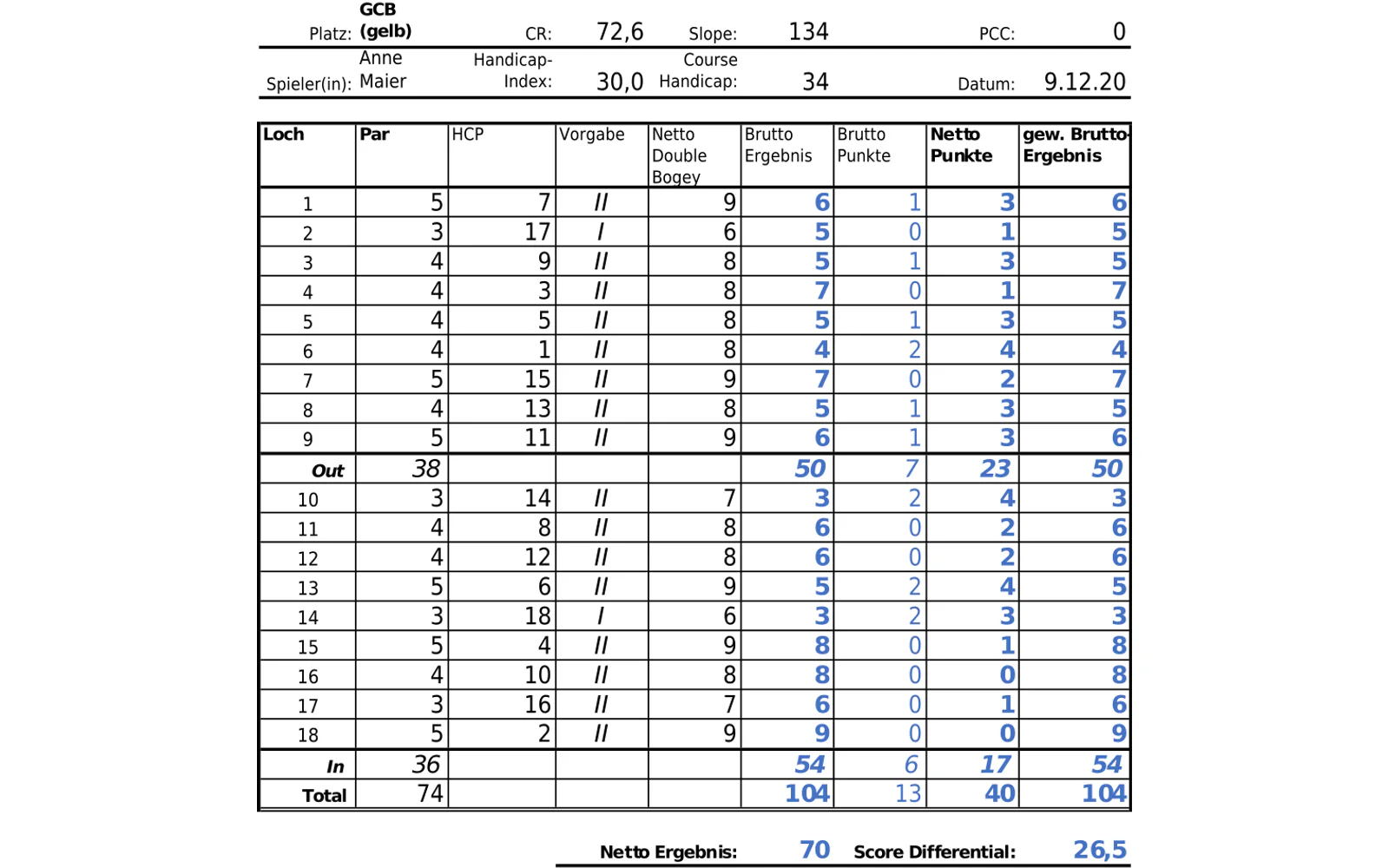
A golfer can have a Handicap Index of one number, a Course Handicap of another and a Playing Handicap of a third. The Score Differential later placed in the record is another decimal number again. A handicap allowance may then alter strokes for the competition format.
All of these numbers have a purpose. Together, they can make a member feel that the system is changing the answer after every step.
The common club response is to explain the complete formula. That is often too much. Most players need three answers:
- What number describes my demonstrated ability?
- How many strokes do I receive from these tees today?
- What number applies in this competition?
The committee needs the full technical explanation. The first tee needs the correct answer in ten seconds.
The second weakness: common rules still allow national choices
The R&A’s online Rules of Handicapping state plainly that some provisions are discretionary and that players should check the selections made by their national association.
National associations can determine matters including authorised formats of play, minimum holes for an acceptable score, active seasons and aspects of score certification. Only certain 18-hole individual stroke-play and Stableford competition formats are mandatory selections. Other formats and general-play arrangements may differ.
This flexibility is understandable. A country where most handicapping happens in organised competitions has a different tradition from one where members routinely submit social rounds. Northern courses may have a defined inactive season; a southern resort may operate throughout the year. Some cultures rely heavily on visible peer review, while others place more of the process in a national digital platform.
The disadvantage is that “world system” can sound more uniform than the golfer’s actual experience. A visiting player still needs clear local guidance about which scores are acceptable and how they must be returned.
More scores can improve the index but also test trust
An eight-from-20 calculation needs scores. General-play and nine-hole submissions can create a more current picture of ability than a record built from a few summer competitions.
The problem is not simply whether many or few scores are submitted. It is whether comparable golfers submit comparable types of rounds.
If one member returns every acceptable social score and another submits only formal competitions, their records are based on different slices of golf. If pre-registration and certification are treated casually, confidence suffers. If the club responds by implying that every unusual score is dishonest, confidence suffers in a different way.
WHS includes peer review, exceptional-score adjustments, caps, penalty scores and committee intervention because an algorithm cannot understand every human circumstance. A rapid improvement, an injury, a missing score and deliberate manipulation can produce patterns that look similar in a report but require very different responses.
Automation has not removed the Handicap Committee
The rules say that the integrity of WHS depends on players, clubs, committees and associations carrying out their responsibilities. The R&A strongly recommends a handicap review at least annually for members whose home club is at that club.
That is more than pressing “run report”.
A sound review considers playing history, unusual score patterns, injuries, improvement or decline, competition and general-play performance, and information from other clubs. Before an adjustment, the player must be informed and allowed to respond.
The calculation service can identify an exception. The committee still has to understand it.
Clubs therefore need trained people, a documented process and continuity when volunteers change. WHS may reduce manual arithmetic, but it increases the importance of data quality and consistent governance.
Technology is both a strength and a dependency
Daily revisions, cross-border records and automatic conversion depend on connected systems. When course data are correct, the experience can be excellent: select the tees, receive the right Course Handicap, submit the score and see the record update.
When the wrong tee is active, par has changed, a nine-hole combination is configured incorrectly or an overseas score does not transfer, the apparent precision becomes frustrating.
This is not an argument for returning to handwritten ledgers. It is an argument for treating course and competition data as operational infrastructure. Someone must own changes to tees, ratings, pars, stroke indexes, active seasons and acceptable-score settings. The club also needs a fallback when connectivity fails.
What a well-run club does differently
A good WHS operation is visible without being noisy.
- It publishes the correct Course Handicap information for every rated set of tees.
- It explains Handicap Index, Course Handicap and Playing Handicap separately.
- It states which general-play formats are acceptable and how a round is registered and certified.
- It checks course data whenever tees, pars or measured lengths change.
- It gives visitors a short local guide rather than assuming their home process is identical.
- It reviews exceptions consistently and gives the player a fair opportunity to explain.
- It offers a practical submission route for members who struggle with the main digital channel.
Most importantly, it avoids pretending that the system is either infallible or hopeless. Both positions are convenient ways to stop managing it.
The verdict
WHS is better than the regional patchwork it replaced. It has improved portability, created a common vocabulary and made nine-hole and shorter-course golf easier to include. Its calculation is responsive and contains sensible safeguards.
Its weaknesses are equally real. The front-end experience can be confusing, national choices remain, digital and course data must be maintained, and trust still depends on how players submit scores and how committees respond.
WHS has not eliminated local golf culture. It has put those cultures inside a shared framework.
That is probably the only realistic way a worldwide handicap system could work. The challenge for clubs is to make the common framework feel clear, fair and human at the point where a golfer actually encounters it.
Sources and further reading
- The R&A: World Handicap System Resources
- The R&A and USGA: World Handicap System Revisions Announced for 2024
- The R&A: Scores Acceptable for Handicap Purposes
- The R&A: Handicap Index Calculation
- The R&A: Course Handicap and Playing Handicap Calculation
- The R&A: Committee Actions
- The R&A: Rights and Responsibilities
- European Golf Association: World Handicap System Adopted in Europe
- Golf Ireland: 2024 WHS Update Resources
- Dansk Golf Union: Handicap Rules 2024 Introduced in Two Phases