
Imagine this message from a golf club:
Green speed: 10 feet. Firmness: 120 gravities.
Many golfers will understand the first number. The second number looks precise, but what should they do with it?
Does 120 gravities mean that the ball will stop beside its pitch mark? Will it take one bounce and check? Will it bounce over the back of the green? Should the golfer land the ball short and let it run?
The honest answer is that the number can help, but not on its own.
Firmness is relevant to golf. It affects how a ball bounces, stops and rolls. It also affects pitch marks, shot choice, course setup and water management. Course teams and championship organisers already measure it.
The more difficult question is whether a raw firmness value is useful to the golfer. A number such as 120 gravities is not yet a common language like a Stimpmeter value. It only becomes meaningful when the club explains the instrument, the test method, the local range and the ball reaction that golfers can expect.
Perhaps the next useful course condition is not only a number. Perhaps it is a number with a translation.
First, gravity has not changed
The term can cause confusion. A reading in gravities does not mean that the golf course has more gravity than normal.
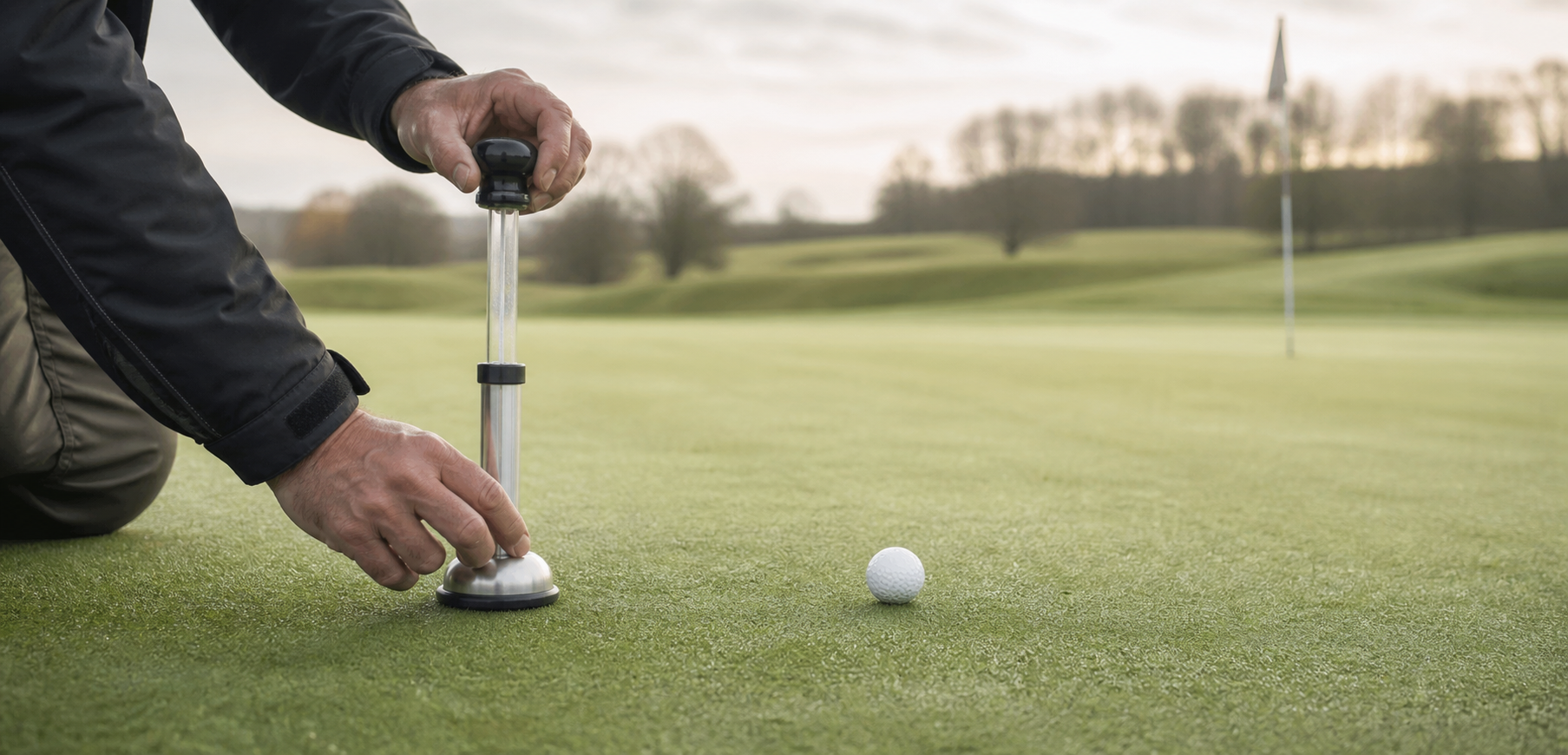
An impact tester drops a small mass onto the turf from a fixed height. An accelerometer inside the mass measures how quickly it stops. The result is compared with the acceleration caused by Earth’s gravity and is often reported as Gmax, g or gravities.
If the hammer stops quickly, the peak deceleration is high and the surface is harder. If the hammer continues slightly farther into the surface before it stops, the peak deceleration is lower and the surface is softer.
The movement can be very small. The change in deceleration can still be large.
This is a measure of the impact response of a surface. It is not a direct measure of soil moisture, soil compaction, ball bounce, green speed or turf health. Those things can influence the result, but they are not the same thing.
How firmness is measured
Golf course teams have more than one firmness tool. The instruments do not all produce the same type of number.
| Method | What it records | What the number means | Common use |
|---|---|---|---|
| Clegg Impact Soil Tester | Peak deceleration of a falling hammer, reported in gravities or a related Clegg unit | A higher value normally means a harder surface | Greens, approaches, fairways, bunkers and sports fields, with different hammers and test methods |
| TruFirm or the firmness function of the USGA GS3 ball | Depth that a dropped plunger or fixture moves into the surface | A lower value means a firmer surface | Putting greens and other golf playing surfaces |
| Stimpmeter | Distance that a ball rolls after it leaves a standard ramp | A longer distance means a faster green | Putting speed, not impact firmness |
The distinction matters. A Clegg value can increase as a surface becomes firmer. A TruFirm or GS3 penetration value moves in the opposite direction because a firm surface allows less penetration.
The USGA guidance for the GS3 ball gives example penetration ranges from 0.300 to more than 0.500 inches. It also tells each course to develop its own benchmarks. The ranges depend on grass, weather, construction, age and golfer expectations.
A club should therefore never publish “firmness 0.36” or “firmness 120” without naming the method and explaining the direction of the scale.
The test method is part of the result
The Clegg device looks simple. Place the guide tube on the surface, lift the hammer to the set height, release it and record the value.
The result still depends on the test protocol.
A golf version can use a rounded 0.5 kilogram hammer. A sports-field version can use a 2.25 kilogram hammer. Drop height, hammer shape, the number of drops and the reported unit can also change.
This is not a small technical detail. A value from one hammer and method is not automatically comparable with a value from another.
Even the label can cause mistakes. Some Clegg systems report gravities or Gmax. Others can report Clegg Impact Value. The manufacturer’s guidance states that one Clegg Impact Value can equal ten gravity units. A value of 12 on one display can therefore describe the same scale position as 120 gravities on another display.
Then there is the sampling method. One reading from the firmest part of one green is not the condition of the course. A proper local test can include several positions across a green, representative greens, approaches and the same collection time on comparable days.
The That full description is much more useful than “we measured 120.”
What happens when the golf ball lands
A soft surface deforms more during impact. It can absorb more of the ball’s downward motion and create a deeper pitch mark. The ball can stop quickly, sometimes close to its first mark.
A firm surface deforms less. The ball is more likely to bounce forward and then roll. The pitch mark is usually smaller. A low shot can release a long way. A steep shot with enough spin can still check, but it may do so after one or more forward bounces.
This is why firmness changes strategy. A front hole position on a receptive green can invite a direct carry. The same hole position on a firm green may require a landing point short of the green. If a bunker or steep slope blocks that route, the golfer may have no reasonable running option.
The R&A makes this point in its course guidance. Very firm greens make it more difficult for many golfers to hold an approach or chip. Tee and hole positions become important when the front of the green does not allow a running shot.
Firmness does not control the ball by itself. The result also depends on:
- ball speed and descent angle;
- backspin;
- the slope at the landing point;
- grass type and the turf canopy;
- moisture and the upper soil profile;
- organic matter and rootzone construction;
- wind and temperature; and
- the first bounce location, which can be an approach, a green or a slope.
Research supports a relationship, but not a perfect prediction. One putting-green study found that Clegg firmness was a moderate predictor of ball-mark size. The relationship explained approximately half of the variation. That is useful evidence for management. It is not enough to calculate the final position of a real approach shot.
A firmness scale can describe ball reaction
The STRI pilot tried to connect Clegg values with golf rather than leaving them as engineering numbers.
With its stated 0.5 kilogram hammer and test method, it described values from 80 to 100 gravities as firm parkland conditions. The expected ball reaction was a forward bounce, a check and then a quick stop. It described 100 to 130 as very firm, with a bounce, check and further roll. Values above 130 were described as hard and unreceptive.
The same report proposed different targets for parkland, heathland and links courses. That is important. It did not treat one number as correct for every form of golf.
The R&A gives a different championship example. At The Open, it aims for approaches and greens between 110 and 150 gravities. It explains that these values relate to links golf, where the running shot is part of the intended challenge.
These ranges should not become a universal club league table. They show that a number needs a purpose. A value that supports the design of a links can make a parkland green with a forced carry too difficult for many golfers.
Firm is not the same as fast
Golfers often join the words “firm and fast.” The two characteristics can occur together, but they are different.
Firmness describes the surface response to impact. Green speed describes how far a rolling ball travels under a standard test.
A green can be firm and relatively slow because of grass growth or mowing height. It can also be soft and quick after aggressive mowing and rolling. Smoothness and trueness are separate again.
This matters if clubs communicate the data. A golfer who reads “firmness 125” should not assume that putts will roll at 12 feet. The number is more relevant to the landing and first bounces of an approach shot than to the pace of a normal putt.
Why the course team can use the number
For the course team, local firmness data can answer practical questions.
Is one green softer than the other seventeen? Does an approach remain wet after rain? Does a change in irrigation alter playing performance? Is topdressing and organic-matter management producing a more stable surface over time? Has a competition setup moved outside the club’s normal range?
The strongest use is comparison within the same course and test method.
The USGA review of putting-green firmness explains why course-to-course comparison is weak. Two greens with the same measured value can give different ball reactions because grass species, rootzone, organic matter and the turf canopy are different. Warm-season turf can also feel firmer to golfers than its measured value suggests when compared with cool-season turf.
Firmness data works best beside moisture readings, ball-reaction observations, pitch-mark size and the maintenance record. It gives the team another view of the surface. It does not replace the course manager.
It can also support a better water conversation. Firm conditions do not mean that the club should simply stop irrigation. The course needs healthy grass, suitable roots and enough moisture. Long-term topdressing, organic-matter control, drainage, grass selection and rootzone properties all affect the possible range.
The measurement vendors are promoting this category
This is not an imaginary measurement that only appears at one championship. There is an established product category.
SD Instrumentation offers a Clegg impact tester with a 0.5 kilogram golf probe, data storage, GPS positions and Bluetooth download. Turf-Tec promotes 0.5 kilogram and 2.25 kilogram Clegg systems for greens, approaches, bunkers and sports surfaces, with app-based logging and mapping.
Spectrum Technologies sells the TruFirm meter, which reports penetration depth rather than gravities. The USGA now promotes the GS3 ball as a way to collect firmness, speed, smoothness and trueness in one process.
The vendors present clear operational benefits: fast testing, repeatable collection, mapping, trend analysis and a way to connect firmness with moisture and maintenance. These are reasonable benefits for a course team that has a defined question and a consistent collection process.
What I did not find was an agreed golfer-facing standard that works like a universal weather scale. The product information is mainly written for turf managers and sports-surface professionals. The tools appear more mature than the public language around them.
That is not a criticism of the vendors. It may simply mean that the next part of the work belongs to clubs, governing bodies and golfers. We need to decide which information is useful to share and how it should be explained.
Football uses the concept, but for a different purpose
Football provides a useful comparison because surface hardness is already part of a wider testing system.
The FIFA test manual for natural playing surfaces specifies a 2.25 kilogram impact hammer and a drop height of 457 millimetres. The result is recorded as Gmax.
FIFA does not treat that value as the full quality of a pitch. Its programme also measures ball rebound, ball roll, shock absorption, vertical deformation, rotational resistance, evenness, moisture, grass cover and other agronomic properties.
That is the useful lesson for golf. A hardness value can be important without becoming the only quality value.
The football and golf numbers must not be compared directly. The hammers, surfaces, test aims and people interacting with the surface are different. In football, player contact and safety are important parts of the discussion. In golf, the main golfer-facing questions concern ball reaction, playability and consistency.
Would the number help you before a round?
This is where the article becomes a question for the golfer.
If the course notice says “124 gravities,” does that change your first approach shot?
Would this be more useful?
Approaches and greens are very firm today. Expect the first bounce to move forward and allow more release. Use a running route where the design permits it.
Would it help if the club added its local value?
Firmness: 124 gravities with our normal Clegg method. Our usual playing range is 90 to 120.
The first message translates the condition into golf. The second adds evidence and shows that the club understands its normal range.
There is also a risk. Once a number is public, golfers can turn it into a competition. If 120 is good, 130 can sound better. We have already seen this behaviour with green speed. A firmness league table could push clubs towards harder surfaces without asking if the ball reaction suits the design, the season or the golfers.
The number should describe the intended golf. It should not become the objective.
A simple communication test for a club
A club that wants to publish firmness can test the idea before it makes a permanent promise.
Use one instrument and one written protocol. Select representative greens and approaches. Measure at the same stage of morning maintenance. Record moisture, weather and recent irrigation. Then observe real ball reaction with a repeatable test shot or launcher where suitable.
For several weeks, publish one of three local descriptions:
- Receptive: the ball is likely to stop close to its first landing area.
- Balanced: a well-struck shot is likely to bounce forward, check and stop within the expected local area.
- Very firm: the first bounce is likely to move forward and the ball will release more than normal.
The club can add the measured range in smaller text. It should also state the instrument if it publishes the raw value.
Ask golfers one useful question after the round:
Did the condition message help you predict how approach shots would react?
Do not ask only if they liked the firmness. A golfer can dislike a demanding condition and still say that the message was accurate. Accuracy and preference are different.
The course team should also ask whether communication caused new misunderstandings. Did golfers confuse firm with fast? Did they compare values with another course using a different device? Did the local description match the ball reaction on all greens or only the measured ones?
That evidence will tell the club if the message is useful.
The verdict
Firmness measurement is real, established and relevant to golf. It helps a course team monitor consistency, evaluate maintenance and prepare the playing challenge. It also connects with something every golfer understands: what the ball does after it lands.
The raw gravity number is more difficult.
It is not universal. The instrument, hammer, drop height, protocol, grass, soil, moisture and course design all affect its meaning. Two courses can report the same number and produce different golf. Two devices can measure firmness and move their scales in opposite directions.
I would not hide the number. I would also not publish it without a translation.
“120 gravities” becomes useful when the golfer also knows that the course is very firm today, that the ball will release more than normal and that a running route is part of the intended shot.
The question is therefore not only, “Can we measure firmness?”
We can.
The better question is, “Can we explain the measurement in a way that helps the golfer play the course?”
That answer still needs to be tested.
Sources and further reading
- The R&A: Pace of Play Manual, The Golf Course
- USGA Green Section: The Complexity of Putting Green Firmness
- USGA Green Section: The GS3 Ball, Understanding the Numbers
- International Turfgrass Society Research Journal: Comparison of TruFirm and Clegg Measurements
- Applied Turfgrass Science: Monitoring and Managing Putting Green Firmness
- ASA, CSSA and SSSA: Using Clegg Firmness to Predict Ball-Mark Size
- Procedia Engineering: Golf Ball Landing, Bounce and Roll on Turf
- FIFA: Test Manual for Natural Playing Surfaces
- Clegg Hammer: How the Clegg Impact Test Works
- SD Instrumentation: Clegg Impact Soil Tester for Golf and Sports Surfaces
- Turf-Tec: Clegg Impact Testers for Golf and Sports Surfaces
- Spectrum Technologies: FieldScout TruFirm Turf Firmness Meter
Evidence reviewed 10 August 2026. Firmness values in this article are examples from the named instruments, methods and course settings. They are not universal targets. Clubs should set local ranges with the course manager and appropriately qualified agronomic advice.