
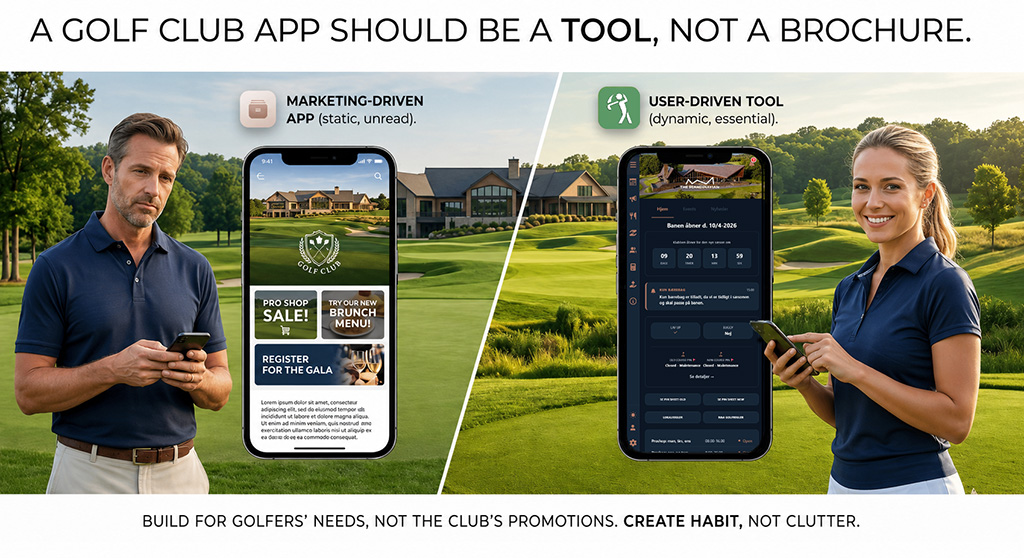
If a golf club app is mostly marketing, it is not really an app. It is a brochure people forget to open.
That is deliberately blunt, but it describes a common mistake. The project begins with a sensible ambition: communicate better with members and guests. It then becomes a list of everything the club would like to publish, including news, sponsor banners, restaurant promotions, event posters, pro-shop offers and photographs.
All of those things may deserve a place. They are simply not the main reason a golfer returns.
The more important question is: what does the golfer need to know or do right now?
The short answer
A useful app is built around repeatable member tasks. A brochure is built around the club’s publishing wishes.
Golfers return for current course status, tee-time information, competitions, local rules, playing conditions, event details and other practical help. If the app deals with those moments reliably, communication and commercial messages gain an audience naturally.
The sequence matters: usefulness first, attention second.
The wrong starting question
Many app discussions begin with “What should we put in it?”
That encourages a feature inventory. Every department adds a page, every stakeholder adds a banner and the home screen becomes a compromise. The result may look complete in a presentation, but completeness is not the same as usefulness.
A better opening question is: “What would make a golfer check this app without being reminded?”
Possible answers include:
- Is the course open?
- Are there temporary greens?
- Are buggies permitted today?
- Which tees are in use?
- Has the starting time changed?
- What is the local rule for the work beside the 7th fairway?
- Where do I meet for the event?
- Can I find someone for a game?
- Who should I contact about the competition?
These are modest questions. That is exactly why they matter. They occur repeatedly and often at moments when a quick, trustworthy answer is valuable.
Build a utility loop
An app earns a place in club life through a simple loop:
- The golfer has a practical question.
- The app provides a clear, current answer.
- The golfer trusts it enough to check again next time.
Every successful repetition strengthens the habit. Every stale or contradictory answer weakens it.
This is why a small dependable app can outperform a large ambitious one. Five functions that work every day are more valuable than 25 sections that are difficult to find or rarely current.
Before a round, the app might show course conditions, restrictions, pin information, today’s operational notice and booking details. At the club or at home, it might provide event instructions, the right contact and relevant competition information. The common feature is usefulness at a recognisable moment.
Why marketing works better in a useful app
Clubs naturally want visibility for events, food and beverage, sponsors, coaching and the professional’s shop. The mistake is to make those messages the reason for the app.
Most people do not form a digital habit around receiving promotions. They tolerate or welcome them inside a service that already gives value.
When a golfer checks the morning course update, they may also notice:
- tonight’s restaurant booking opportunity;
- an open place in Sunday’s competition;
- a sponsor-supported club event;
- a coaching clinic;
- a relevant shop offer.
The promotional message has not disappeared. It has been placed inside a useful visit rather than being asked to create the visit.
This is a healthier test for every home-screen item: does it help the golfer, support the club, or both? If it serves only an internal desire to publish, it may belong deeper in the app or outside it.
Downloads are not the goal
A launch campaign can produce an impressive number of downloads. That number is easy to report and not very useful on its own.
An installed app can sit unopened for months. The stronger measures concern behaviour and outcomes:
- How many active members return in an ordinary week?
- Which practical tasks are completed?
- How quickly do members find course information?
- How current is the information they see?
- Do routine calls to the office reduce?
- Are event details read before repeated questions arrive?
- Do different member groups receive equal value?
The most revealing question may be qualitative: if the app disappeared tomorrow, what would members miss?
If the answer is only “the news”, email and the website may already serve the need. If members would miss the current course status, playing-partner function, competition information and one dependable place to check the day, the app has become a tool.
Freshness is a product feature
The member experience depends on what staff can maintain on a busy Tuesday morning.
This operational side is often underestimated. A club can choose the right features and produce an attractive design, yet still fail because updating important information takes too long or depends on one person.
Dynamic content needs an owner. For each item, the club should know:
- who is responsible;
- how often it may change;
- where the source of truth sits;
- how many steps an update requires;
- who covers absence;
- when old information expires automatically.
Consider a buggy-status notice. If the course team must send a message to the office, which then contacts an agency, which then publishes an update, the app will frequently be behind reality. If the responsible person can change one controlled field from a phone, the information has a chance of remaining useful.
This does not mean everyone should be able to publish everything. Permissions should follow responsibilities. The greenkeeping team may own course status, the competition team may own event instructions and management may own emergency notices. Simple workflows can still include review where the risk justifies it.
Maintenance is not an afterthought. It is part of the design.
One source of truth beats five copies
Golf clubs often repeat information in the app, website, booking system, email, social media and clubhouse. If each copy is updated separately, contradictions are almost guaranteed.
The answer is one clear source of truth for each kind of information, connected to the channels where golfers need it. Map where content is created, who verifies it, where it appears and which channel is authoritative. A polished screen showing yesterday’s status is worse than a plain screen showing today’s.
Design for the whole club
Golf clubs serve members, visitors, seasonal players, staff and volunteers with different languages and levels of digital confidence. Do not assume behaviour from age; test real tasks with real people.
Good fundamentals help everyone:
- plain labels instead of internal terminology;
- strong contrast and readable type;
- large, forgiving touch targets;
- a logical path to the most-used functions;
- alternatives to colour-only status;
- useful text alternatives for images;
- no essential information hidden in a PDF;
- clear language selection where a club serves several nationalities.
The Web Content Accessibility Guidelines 2.2 provide a sound technical reference even where a particular legal requirement does not apply. Accessibility should not be treated as a specialist add-on. Golfers checking a screen outdoors, in bright sun, with one hand occupied, benefit from the same clarity.
Operating cultures matter too. A Nordic club may favour self-service updates, a traditional British or Irish club may rely on sections, and a Mediterranean resort may prioritise multilingual guest information. These are hypotheses, not national rules.
The counterargument: sometimes the brochure is enough
Not every club needs a feature-rich app.
If information changes infrequently and members already use established booking and competition systems, another app may add duplication. Integration also requires time, governance and supplier cooperation. The honest choice may be to improve the website, email discipline and existing tools instead.
The problem is not having a digital brochure. The problem is calling it an essential member app and expecting repeat behaviour that its content cannot support.
A practical app audit
Ask a small group of members and staff to complete five common tasks without guidance. Observe where they hesitate; do not explain the intended route.
Then review the app against these questions:
Usefulness
- What are the three strongest reasons to open it today?
- Are those reasons visible immediately?
Currency
- Which information can become dangerously or frustratingly stale?
- Does every dynamic item have an owner and expiry rule?
Trust
- Does the app agree with the website, booking system and clubhouse?
- Is the time of the latest operational update visible?
Inclusion
- Can the core tasks be completed with enlarged text and keyboard or assistive navigation?
- Is important information available as text rather than only in images or PDFs?
Measurement
- Are repeat use and completed tasks measured, rather than only downloads?
- Is there a scheduled decision to improve, remove or simplify weak sections?
An audit like this is more valuable than asking whether the app looks modern.
Dependability is the ambition
The best club app is not necessarily the one with the longest menu or the most animated home screen. It is the one golfers trust.
That trust is earned in small moments: the course status is correct, the event instruction is easy to find, the local rule is current and the relevant person can update information without a technical project.
Once usefulness creates a habit, news and promotion have a fair opportunity to be seen. Without that habit, even excellent content is being published into an empty room.
The strategic question is therefore not “What can we promote through an app?”
It is “What would make a golfer feel that this app is worth checking every time they play?”
The answer should shape the product, the content and the operating model. Because the goal is not to launch an app. The goal is to create something the club can maintain and golfers would genuinely miss.
Sources and further reading
- W3C: Web Content Accessibility Guidelines (WCAG) 2.2
- Directive (EU) 2019/882: European Accessibility Act
- Regulation (EU) 2016/679: General Data Protection Regulation
- Internal How Many Strokes paper: A Golf Club App Should Be a Tool, Not a Brochure (used as the primary editorial viewpoint; not a public source)
The legal scope of accessibility and data-protection rules depends on the organisation, service and jurisdiction. The standards above are included as authoritative design references, not as legal advice.