
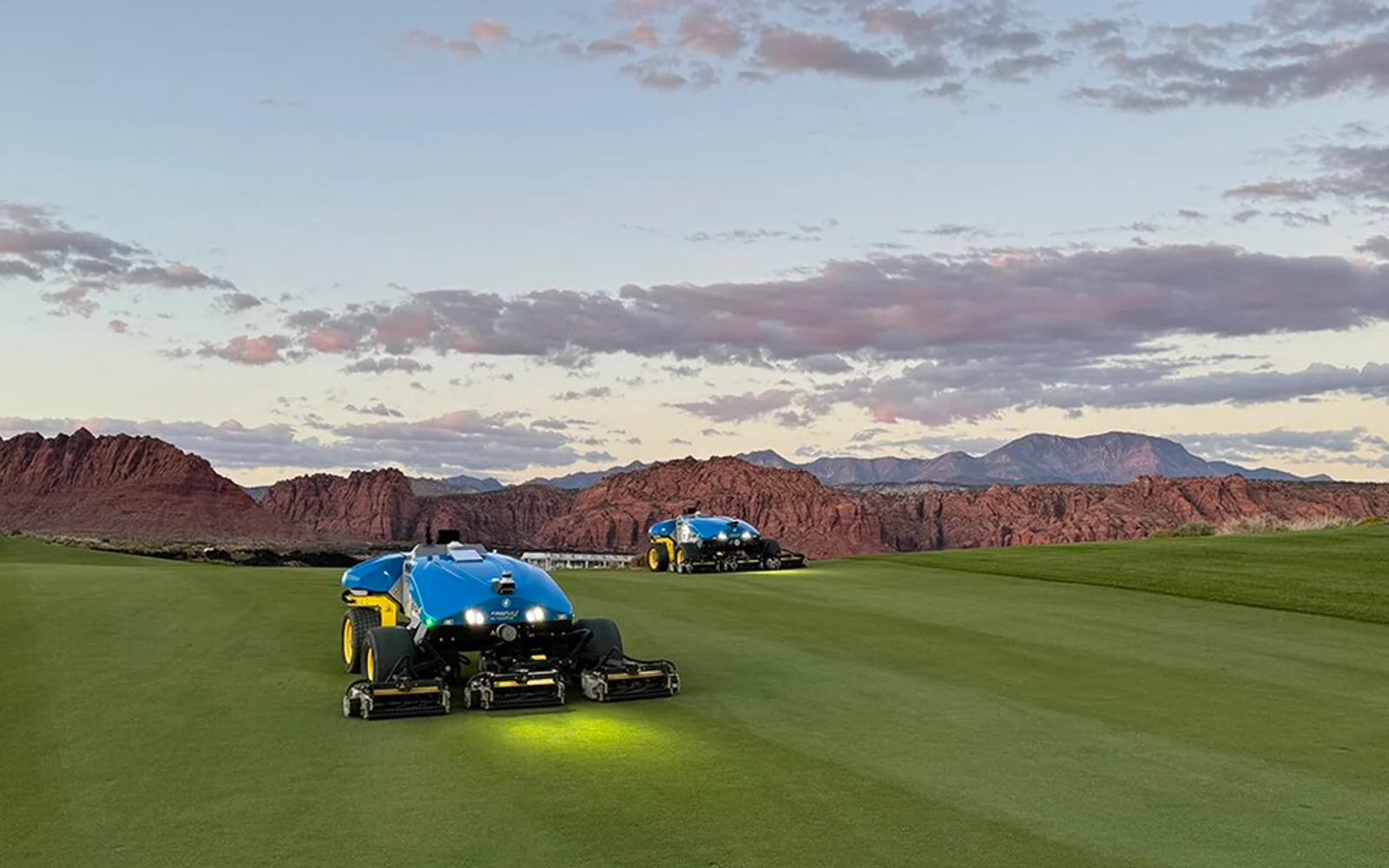

A robotic mower makes less noise than a conventional diesel machine. It does not wave a golfer through, make eye contact or understand that somebody is about to hit a seven-iron into its path.
So, are robotic mowers annoying?
The best available golfer research suggests that most players accept them or actively prefer them. The minority concerns are still worth taking seriously. A mower in the landing area, an unclear safety policy or a club that has said nothing about the new machines can turn quiet technology into a visible irritation.
The important variable is not only the robot. It is how the club operates it.
What golfers in the Nordic trials said
The most useful evidence comes from the ROBO-GOLF project led by the Norwegian Institute of Bioeconomy Research, with trials on golf courses in Norway, Sweden, Finland, Iceland and Denmark.
A web survey at three courses in Norway, Denmark and Sweden examined golfer attitudes. Most respondents were club members and most had played golf for at least six years. According to the later USGA summary of the research, 90% reported positive feelings or feelings similar to those they had about conventional mowers.
Players commonly noticed:
- less noise;
- fewer waits for large mowing machines;
- more even and dense turf;
- a ball sitting more visibly on top of the grass;
- fewer clippings;
- less morning dew; and
- more greenkeeping time available for other work.
Negative responses were uncommon, at less than 10% across the three surveyed courses, but they were specific. Some golfers disliked a robot in the landing area, worried about balls hitting machines or machines hitting people, raised wildlife concerns or asked why mowing could not happen only at night.
This is encouraging evidence, but three Nordic member clubs cannot represent every links, resort and parkland course. The respondents were experienced golfers familiar with the machines. A visitor encountering one for the first time may react differently.
Quiet is a major benefit, but noise is not the whole experience
Commercial robotic mowers are quieter than many conventional machines. As one example, the manufacturer’s manual for Husqvarna CEORA systems lists a perceived sound level of approximately 69 to 72 dB(A), depending on the configuration. Smaller commercial units may be lower.
Sound measurements depend on the method, distance and operating conditions, so a figure for one robot is not directly interchangeable with a measurement beside a large fairway mower.
The practical difference is obvious enough without doing decibel theatre. Electric robots have no diesel engine working under load, and the lightweight cutting system makes a much softer sound. They also produce no exhaust fumes at the point of use.
Yet annoyance is partly visual and situational. A quiet object repeatedly crossing a golfer’s field of view can be more distracting than a greenkeeper who approaches once, pauses and clearly signals that it is safe to play. A robot close to the expected landing area creates uncertainty even when it poses little actual risk.
The operational answer is to park or redirect machines during peak play, important competitions and periods when a work zone sits directly in the normal shot pattern. Quiet operation gives the club more scheduling options. It should not become an excuse to mow everywhere all the time.
The playing surface can improve, but not every grass responds alike
Robotic mowing changes the pattern of maintenance. Instead of removing more growth a few times a week, a robot cuts a small amount frequently. The machine is much lighter than a conventional fairway unit and returns fine clippings.
In the controlled Nordic research, robotic mowers generally produced acceptable turf quality. On some fairway grasses, quality later in the season was better than under conventional mowing. Frequent movement also removed dew, and the research found less white clover in robot-mown fairway plots and a tendency towards less disease in some settings.
The results were not uniformly positive. In parts of the rough trial, robot-mown perennial ryegrass and red fescue had lower quality later in the season. Researchers suggested that mowing too often when growth did not require it may have contributed. They also found no difference in fertiliser requirement, despite the reasonable theory that frequent fine clippings might reduce it.
A 2025 case study at Montecchia Golf Course in Italy reached a similarly balanced conclusion. Daily autonomous mowing maintained acceptable fairway standards, but the conventional reel mower produced higher visual quality in several months and better colour throughout the study period.
The lesson is not “robots improve turf”. It is “robots can maintain good turf when frequency, height and grass species are managed correctly”. A machine that never tires can still mow too much.
Sustainability gains are real, but site-specific
Moving from diesel to electricity removes tailpipe emissions on the course and can reduce operating carbon. The size of that reduction depends on the electricity mix, the conventional equipment being replaced, utilisation, battery life and how long the robot remains in service.
The Italian case study estimated annual emissions for mowing 10.69 hectares (26.4 acres) of fairways on a 27-hole site. Its conventional approach used 5,346 litres of diesel and was estimated at 13,953 kilograms of carbon dioxide (30,761 lb). Six autonomous mowers used an estimated 8,892 kWh and, with the study’s electricity factor, produced an estimated 4,713 kilograms (10,390 lb).
That is a substantial modelled reduction for that course. The authors explicitly warned that grid carbon factors vary by region and season. The calculation did not make the battery, charging infrastructure and machine manufacture disappear.
The financial result was sensitive to service life. The autonomous option became cheaper in the study’s eight- and ten-year scenarios but not in the five-year scenario. A club that replaces an unreliable fleet early may lose much of the promised economic and environmental advantage.
Good procurement therefore asks about repairability, batteries, blade and tyre consumption, software support, connectivity fees and expected service life, not just electricity per mowing hour.
Safety features help; a safety system still needs people
Current commercial robots may include virtual boundaries, stay-out zones, object detection, lift and tilt sensors, warning lights and remote fleet controls. Manufacturers state that cutting discs stop when a machine is lifted or tipped, and some machines slow before contact.
Those are important controls. They do not remove the club’s responsibility to assess how a particular model behaves in a public playing environment.
A practical policy should cover:
- separation from tees, greens and likely landing zones during busy periods;
- remote-stop and recovery procedures;
- charging stations and routes that do not create trip or play hazards;
- daily inspection of blades, guards, sensors and mapped boundaries;
- safe isolation before cleaning or maintenance;
- what staff do when positioning data or connectivity is lost; and
- how players report a stopped, damaged or misplaced machine.
The Rules of Golf already deal with outside influences. If a ball in motion accidentally hits one, there is normally no penalty and the ball is played as it lies, subject to the exceptions in Rule 11. If a ball at rest is moved by an outside influence, Rule 9.6 normally requires replacement. A short notice can explain what to do and whom to contact.
Wildlife makes “just mow at night” the wrong default
Night operation sounds attractive: no golfers, cooler conditions and an empty course. On a course with nocturnal wildlife, it can create a different conflict.
A 2024 peer-reviewed study tested 19 robotic lawn-mower models against European hedgehog cadavers. Some models caused injury while others did not. With one exception, the machines had to make physical contact before detecting the hedgehog. Smaller hedgehogs were more vulnerable.
An earlier study recommended avoiding night mowing and checking the area for vulnerable wildlife, including hedgehogs, leverets, fledglings and amphibians.
Those experiments do not quantify the risk on every course, but they are relevant wherever hedgehog habitat and nocturnal wildlife are present. “It has a sensor” is not enough evidence that a model is wildlife-safe.
Daylight operation, defined no-mow habitat, pre-run checks, seasonal schedules and model-specific safety evidence can all reduce risk. The best time for golfers is not automatically the best time for nature.
Robots do not replace the course team
The Nordic trials reported a learning period. Clubs needed electricity on the course, new tools and parts, regular blade changes and somebody responsible for programming and maintenance. As the fleet grows, monitoring stopped machines, damaged blades, mapping and charging becomes a role of its own.
The realistic labour benefit is not an empty maintenance facility. It is skilled people spending fewer hours driving repetitive mowing routes and more time on irrigation, bunkers, drainage, disease monitoring, presentation and repair.
Players are more likely to accept automation when they can see what that released time improves. If staffing is simply removed and all the finishing work declines, the robot will be blamed even when its cut is acceptable.
A sensible club introduction
Start with one controlled area rather than a fleet-wide promise.
Run a fairway or semi-rough pilot through different growth and weather conditions. Measure turf quality, stoppages, staff hours, electricity, parts, ball interference and player comments. Record complaints by location and time, not only as “likes” and “dislikes”.
Before the first run, show members what the mower does, where it will work and how it reacts to balls and people. State when it will be parked. Give the course team authority to change the schedule when play or turf conditions require it.
A quiet machine may be especially welcome at a compact course beside housing. A resort visitor who has never seen one may need more obvious signage. Members who value traditional stripes may judge presentation differently from players who primarily want a consistent lie. Cool-season Nordic trial results should not be copied uncritically onto warm-season southern turf.
The pilot should discover those differences, not argue them away.
The verdict
Robotic mowers are not inherently annoying. The available golfer research suggests that most players are positive or indifferent once they understand the machines and experience the quieter, more consistent operation.
They become annoying when the club treats low noise as invisibility, lets machines wander through landing areas, fails to explain ball interference, over-mows the turf or shifts work to the night without considering wildlife.
The best robotic mower programme is almost boring: clear zones, sensible timing, measured results, maintained equipment and a course team visibly in control.
That is not replacing greenkeeping with technology. It is greenkeeping with a different tool.
Sources and further reading
- USGA Green Section: How Do Robot Mowers Affect Turf Management and the Golfer Experience?
- NIBIO: ROBO-GOLF Project
- STERF: ROBO-GOLF Final Findings
- Agrosystems, Geosciences & Environment: Autonomous and Reel Mowers in Golf Course Fairway Maintenance
- Husqvarna: CEORA Operator’s Manual and Technical Data
- Aarhus University: Testing Robotic Lawn Mowers Against European Hedgehogs
- Animals: Wildlife Conservation and Robotic Lawn Mowers
- The R&A: Rule 11, Ball in Motion Accidentally Hits a Person, Animal or Object
- The R&A: Rule 9, Ball Played as It Lies; Ball at Rest Lifted or Moved